
Applying for a credit card that advertises 5% to 10% discounts on dining, groceries, or online shopping feels like a smart financial move. However, many cardholders in Korea notice a puzzling discrepancy when reviewing their monthly bank statements: despite spending over 1,000,000 KRW, their actual monthly statement savings rarely exceed 10,000 KRW.
Advertised credit card discount rates are often deceptive. Card issuers attach complex conditions, such as minimum previous month spending requirements (전월 실적), low integrated monthly discount caps (통합 할인 한도), and long lists of excluded expense categories. To earn a modest discount, cardholders frequently end up spending hundreds of thousands of KRW on unnecessary purchases just to qualify.
This guide exposes the hidden mechanics behind credit card discount structures in Korea, provides a simple formula to calculate your real net savings, and shows you how to restructure your credit cards to stop losing money.
The extra spending trap: Why minimum monthly requirements force you to waste money
Credit card issuers design discount structures to encourage higher overall monthly spending. The primary mechanism used to achieve this is the previous month spending requirement (전월 실적).
The previous month spending trap (전월 실적)
Most mid-tier discount cards in Korea require you to spend between 300,000 KRW and 500,000 KRW in the current month to activate discount perks for the following month. If your spending falls even 10,000 KRW short of this threshold on the last day of the month, all card discounts are completely deactivated for the entire next month. To avoid losing perks, cardholders routinely buy non-essential items at month-end, creating extra spending that far outweighs any discount earned.
The excluded categories trap (실적 제외 항목)
The most deceptive aspect of Korean credit cards is the list of expenses excluded from performance calculations (실적 제외 항목). Card issuers routinely exclude essential fixed living costs, such as:
- Apartment management fees (아파트 관리비) and utility bills (공과금)
- Local and national taxes (지방세/국세) and school tuition fees
- Purchases that received a discount: Ironically, on many Korean cards, any transaction that successfully receives a discount is completely excluded from counting toward next month’s minimum spending requirement!
If you spend 300,000 KRW on discounted items, your qualifying performance count for next month remains 0 KRW, forcing you to spend an additional 300,000 KRW on non-discounted items just to maintain your card benefits.
The math formula to calculate your real net discount rate
To determine whether a card is truly saving you money, you must calculate your effective net discount rate rather than relying on advertised percentages.
Subtracting annual fees and foreign transaction costs
An annual fee (연회비) silently reduces your net savings. For example, if a card charges a 20,000 KRW annual fee and yields 5,000 KRW in monthly discounts, your first four months of discounts merely pay off the annual fee.
Furthermore, if you use the card for overseas online shopping or travel, foreign transaction fees (usually around 1.2% to 3%) will instantly wipe out modest domestic cashback gains.
Accounting for monthly integrated discount caps
Korean credit cards enforce an “Integrated Monthly Discount Cap” (통합 할인 한도). A card may advertise a 10% discount on coffee and dining, but limit total combined savings to 5,000 KRW per month.
If you spend 500,000 KRW on your card to earn that capped 5,000 KRW discount, your real net discount rate is calculated as:
Effective Discount Rate = (5,000 KRW Savings / 500,000 KRW Total Spend) × 100 = 1.0%
An advertised 10% card that yields a 1% real discount rate is costing you money if it forces you into non-essential spending.
Comparing card strategies: No-condition flat-rate cards vs category-focused cards
To optimize your wallet, you must choose a card strategy that matches your actual spending habits:
| Feature / Criteria | No-condition flat-rate card (무조건 카드) | Category-focused discount card |
| Previous month spending requirement | None (0 KRW) | High (300,000 – 500,000 KRW) |
| Discount / Cashback rate | Flat 0.7% – 1.2% on all purchases | High 5% – 10% on specific categories |
| Monthly discount cap | Unlimited (or very high) | Strictly capped (e.g., 5,000–10,000 KRW) |
| Excluded categories risk | Minimal | Very high (many items excluded) |
| Best for | Irregular spenders or general purchases | High spenders with fixed, predictable habits |
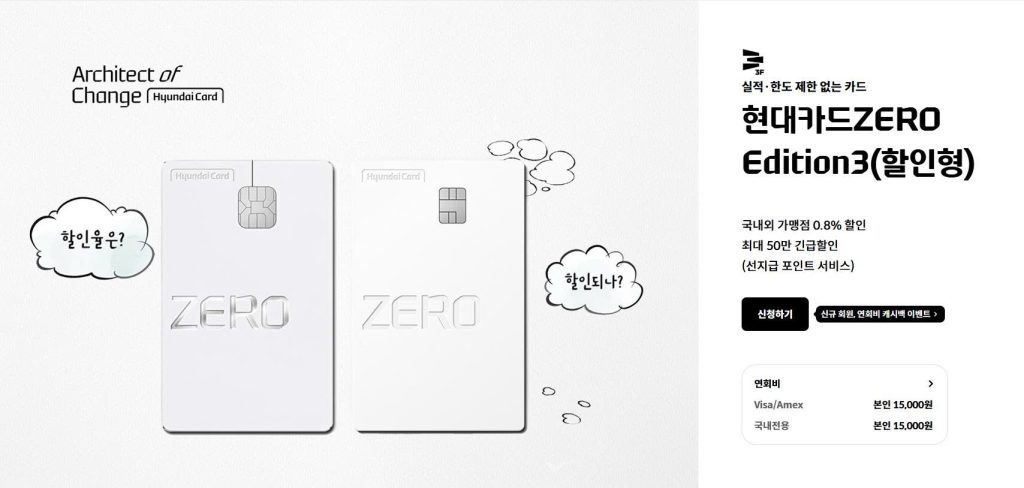
For average consumers, switching to a “No-Condition Card” (무조건 카드) like Hyundai Card Zero or Shinhan Simple yields higher real net savings because you never have to overspend to meet monthly performance thresholds.
3 steps to restructure your credit card spending and stop wasting money
Follow this three-step roadmap to eliminate card-induced overspending and ensure every won spent generates real value:
Step 1: Audit 3 months of bank statements
Review your last three monthly credit card statements. Separate every transaction into three groups:
- Purchases that received a discount.
- Purchases that received no discount.
- Purchases excluded from previous month performance calculations.
Calculate your actual net savings by subtracting annual fees from total discounts received. If your net discount rate is under 1.5%, your current card structure is inefficient.
Step 2: Apply the multi-card splitting strategy (카드 쪼개기)
If you keep a category-focused discount card, use it strictly for its high-discount categories up to the monthly cap (e.g., spending exactly enough on transport or gas to max out the 5,000 KRW cap). Once the cap is reached, route all remaining daily spending to a no-condition flat-rate card.
Step 3: Switch to no-fee or flat-rate options
If maintaining your current card requires artificial end-of-month spending, request a product change or cancel the card. Replace it with a no-condition card that earns 0.7% to 1.2% flat cashback on all expenses without previous month performance stress.